What if the ancient Art of Memory was about far more than remembering?
For classical and Renaissance thinkers, memory could be constructed as an architecture: familiar places filled with vivid images, through which knowledge could be stored, ordered and recovered. But during the Renaissance, this ancient mnemonic technique developed into something considerably more ambitious.
In this presentation, we trace the Art of Memory from the classical method of Simonides, Cicero, Quintilian and the Rhetorica ad Herennium through its medieval development and into the extraordinary memory systems of Giulio Camillo and Giordano Bruno.
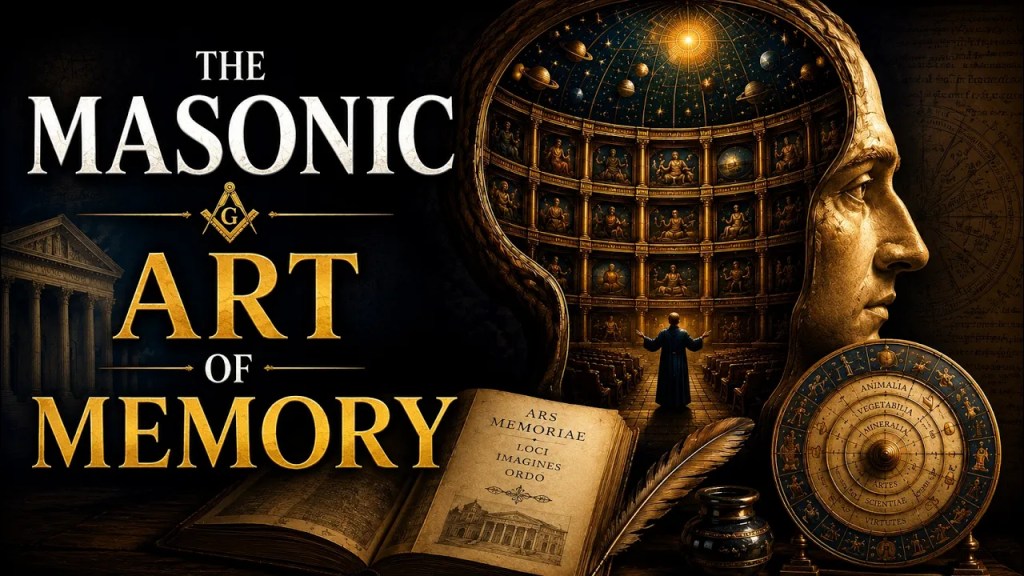
At the centre of the story stands Camillo’s remarkable Theatre of Memory, an attempt to arrange human knowledge within a symbolic architecture structured by the seven planets and the hierarchical order of creation. With Bruno, the system becomes more elaborate still: mnemonic images, astrological symbolism and combinatory wheels become instruments not simply for retaining information, but for organising the operations of imagination and thought.
We explore:
• the classical method of loci, or memory palace
• why bizarre, violent and extraordinary images were considered especially memorable
• the distinction between memoria rerum and memoria verborum
• the medieval relationship between memory, prudence and moral formation
• Ramon Llull and the development of combinatory systems
• Giulio Camillo’s lost Theatre of Memory
• planetary symbolism and Renaissance cosmology
• Giordano Bruno’s De umbris idearum and mnemonic wheels
• the relationship between memory, imagination, Hermeticism and Renaissance magic
• Frances Yates and the modern interpretation of the Renaissance memory tradition
• and the extraordinary idea that a properly ordered memory might become an image of the world itself
The Renaissance Art of Memory occupied a territory we now divide between psychology, rhetoric, philosophy, information management, religion and esotericism. Its most ambitious practitioners were not simply asking how much information a person could remember. They were asking a much stranger question: Could the structure of knowledge, and perhaps even the structure of the cosmos, be reproduced within the human mind?


Leave a Reply